
Tuesday, October 23, 2012


Sunday, October 21, 2012
The Numbers Don't Lie
- $15 Trillion spent on welfare programs since Great Society launched
- 80 current federal social welfare programs
- $2.3 dollars spent on welfare for every dollar spent on defense
- Welfare spending has jumped 23% since 2008
- Poverty rate was 15% at the launch of Great Society
- Poverty rate today is still 15%
- Net benefit of federal welfare spending: Zero
Friday, October 19, 2012
Media Double Standard

Us Magazine had a little tidbit of gossip when it discovered who made Ann Romney's and Michelle Obama's hot pink dresses worn to the recent presidential debate. In its headline Us blares that Ann Romney's dress cost "$1,690." But Michelle Obama's ensemble was priced at $3,290 despite the silence of the headline.
Us gives the world the following headline: "0."In the body of the piece Us reports this description of Ann Romney's couture.Romney, 63, selected a short-sleeved crimped cotton silk dress by Oscar de la Renta. The Spring 2013 design is not yet available in stores, but retails for $1,690.I expect we are supposed to find it shocking, downright shocking, that a millionaire could afford to fork out nearly $1,700 for a frock.
And yet, "public servant" Michelle Obama's outfit was almost twice as costly as Romney's.Obama, 48, styled a shift dress and cropped jacket from Michael Kors' 2013 resort collection. The dress retails for $1,795 and the jacket is $1,495.Notice that Mrs. Obama’s getup rings in at a hefty $3,290 while Ann Romney’s is just over half that. So, why wasn't the headline about Michelle? Her cost was more shocking than Ann's.
http://www.breitbart.com/Big-Journalism/2012/10/18/Us-Touts-Expense-of-Ann-Romney-s-Dress-Buries-Higher-Cost-of-Michelle-Obama-s
The Fruits of a Govt Run Business are...Nothing

Volt No Jolt: LG Chem Employees Idle
Factory has yet to ship out a single battery
Updated: Friday, 19 Oct 2012, 5:14 PM EDT
Published : Thursday, 18 Oct 2012, 4:58 PM EDT
Published : Thursday, 18 Oct 2012, 4:58 PM EDT
By Ken Kolker
HOLLAND, Mich. (WOOD) - Workers at LG Chem, a $300 million lithium-ion battery plant heavily funded by taxpayers, tell Target 8 that they have so little work to do that they spend hours playing cards and board games, reading magazines or watching movies. They say it's been going on for months.
"There would be up to 40 of us that would just sit in there during the day," said former LG Chem employee Nicole Merryman, who said she quit in May.
"We were given assignments to go outside and clean; if we weren't cleaning outside, we were cleaning inside. If there was nothing for us to do, we would study in the cafeteria, or we would sit and play cards, sit and read magazines," said Merryman. "It's really sad that all these people are sitting there and doing nothing, and it's basically on taxpayer money."
Two current employees told Target 8 that the game-playing continues because, as much as they want to work, they still have nothing to do.
"There's a whole bunch of people, a whole bunch," filling their time with card games and board games," one of those current employees said.
That employee says some workers are doing odd jobs around the building, including cleaning and maintenance, while others hang out in the cafeteria playing video games, Texas hold-'em and Monopoly or doing Sudoku or crossword puzzles -- all on company time. The employee said some watch movies.
"There's no work, no work at all. Zero work," another current employee said. "It is what it is. What do you do when there's no work?"
They told Target 8 they didn't want to talk on camera or be identified because workers signed a confidentiality agreement.
Randy Boileau, a Holland-based public relations specialist who was spokesman for LG Chem , says he no longer represents the company.
Target 8 left a message at the plant's security station and left a message with the company's receptionist. The receptionist would not transfer the call to a company manager.
The Target 8 investigation has led the Washington, D.C.-based Recovery Accountability and Transparency Board -- an oversight agency for the federal stimulus program -- to take action.
"We are sending this to the Inspector General, Department of Energy, for his review," said Ed Pound, spokesman for the board. The Inspector General's Office would decide whether to open an investigation. Pound refused further comment.
Some workers at the Holland plant have quit or are looking for jobs. Others have started helping local non-profits on company time.
"I thought it might be a decent place to start a career, lots of places to move up," said one former employee, who left the job this summer.
"You can only do nothing for so long. There were days, sitting around all day doing nothing. ... I didn't play a whole lot of cards," said the worker, who added, "I bailed out of a sinking ship."
Those left behind are on furlough -- one week off without pay every four weeks.
The plant all started with such great hope, and a presidential groundbreaking in July 2010.
"This is a symbol of where Michigan is going, this is a symbol of where Holland is going, and this is a symbol of where America's going," President Barack Obama told a crowd at the groundbreaking.
Nicole Merryman was among the first in line for a job.
"It was something exciting, and I thought it would be better for the family, more overtime, more money," said Merryman, who said she worked on a line that folded the battery cells.
The company's goal: 300 employees pumping out 15 million battery cells a year. Its biggest customer: The Chevrolet Volt.
The U.S. Department of Energy provided a $151 million grant, part of Obama's Recovery Act.
The Korea-based company recently said it has 200 employees, and the company's most recent federal filing shows 100 of them are funded through the Recovery Act grant.
The company has spent $133 million so far, most for construction and equipment, records show. About 40% has gone to foreign companies -- mostly to Korea, a Target 8 analysis shows.
The company also spent more than $533,000 of that federal grant for the groundbreaking, records show.
A Target 8 analysis of federal records shows taxpayers spent $7 million to train workers and have paid more than $700,000 for workers' health and dental insurance.
There's millions of dollars more at stake for LG Chem if it doesn't keep hiring, or if its job numbers fall. The state approved a $25.2 million job-creation state tax credit over 15 years, and a battery cell state tax credit worth $100 million over 4 years. Both are tied to job creation.
LG Chem has yet to file claims for that money, state officials said.

President Obama’s Taxpayer-Backed Green Energy Failures
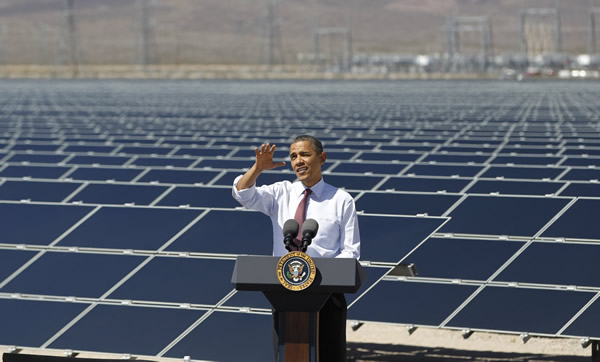
The truth is that the problem is widespread. The government’s picking winners and losers in the energy market has cost taxpayers billions of dollars, and the rate of failure, cronyism, and corruption at the companies receiving the subsidies is substantial. The fact that some companies are not under financial duress does not make the policy a success. It simply means that our taxpayer dollars subsidized companies that would’ve found the financial support in the private market.
So far, 36 companies that have received federal support from taxpayers have either gone bankrupt or are laying off workers and are heading for bankruptcy. This list includes only those companies that received federal money from the Obama Administration’s Department of Energy. The amount of money indicated does not reflect how much was actually received or spent but how much was offered. The amount also does not include other state, local, and federal tax credits and subsidies, which push the amount of money these companies have received from taxpayers even higher.
The complete list of faltering or bankrupt green-energy companies:
- Evergreen Solar ($24 million)*
- SpectraWatt ($500,000)*
- Solyndra ($535 million)*
- Beacon Power ($69 million)*
- AES’s subsidiary Eastern Energy ($17.1 million)
- Nevada Geothermal ($98.5 million)
- SunPower ($1.5 billion)
- First Solar ($1.46 billion)
- Babcock and Brown ($178 million)
- EnerDel’s subsidiary Ener1 ($118.5 million)*
- Amonix ($5.9 million)
- National Renewable Energy Lab ($200 million)
- Fisker Automotive ($528 million)
- Abound Solar ($374 million)*
- A123 Systems ($279 million)*
- Willard and Kelsey Solar Group ($6 million)
- Johnson Controls ($299 million)
- Schneider Electric ($86 million)
- Brightsource ($1.6 billion)
- ECOtality ($126.2 million)
- Raser Technologies ($33 million)*
- Energy Conversion Devices ($13.3 million)*
- Mountain Plaza, Inc. ($2 million)*
- Olsen’s Crop Service and Olsen’s Mills Acquisition Company ($10 million)*
- Range Fuels ($80 million)*
- Thompson River Power ($6.4 million)*
- Stirling Energy Systems ($7 million)*
- LSP Energy ($2.1 billion)*
- UniSolar ($100 million)*
- Azure Dynamics ($120 million)*
- GreenVolts ($500,000)
- Vestas ($50 million)
- LG Chem’s subsidiary Compact Power ($150 million)
- Nordic Windpower ($16 million)*
- Navistar ($10 million)
- Satcon ($3 million)*
The problem begins with the issue of government picking winners and losers in the first place. Venture capitalist firms exist for this very reason, and they choose what to invest in by looking at companies’ business models and deciding if they are worthy. When the government plays venture capitalist, it tends to reward companies that are connected to the policymakers themselves or because it sounds nice to “invest” in green energy.
The 2009 stimulus set aside $80 billion to subsidize politically preferred energy projects. Since that time, 1,900 investigations have been opened to look into stimulus waste, fraud, and abuse (although not all are linked to the green-energy funds), and nearly 600 convictions have been made. Of that $80 billion in clean energy loans, grants, and tax credits, at least 10 percent has gone to companies that have since either gone bankrupt or are circling the drain.
Posted in Energy and Environment, Featured
Wednesday, October 17, 2012

Subscribe to:
Posts (Atom)
